
Tiny teams don’t succeed despite their size. They succeed because of it.
This article introduces the Inverse Cognitive Maneuver, a framework for using your team’s cognitive limits as a product strategy rather than a problem to solve. It draws on research from Brooks, Ringelmann, Dunbar, and Cowan, examines companies from Telegram to Evernote, and provides a practical tool (the 10-slot budget) you can apply Monday morning.
Contents
Telegram serves 1 billion users with around 30 engineers. Not 30 engineers on the messaging team. 30 engineers total. Encryption, multi-platform clients, infrastructure, everything. $30 billion valuation. Pavel Durov is still the only product manager.
Most companies would staff that with 300 engineers minimum. Telegram does it with 30. And they’re not planning to change.
This isn’t luck or talent. It’s a deliberate strategy, one that has a name, a theory behind it, and a growing body of evidence.
Telegram isn’t alone:
-
WhatsApp had 55 employees serving 450 million users when Facebook paid $19 billion. Roughly 8 million users per employee.
-
Instagram sold for $1 billion with 13 employees. Two years from launch to exit.
-
Basecamp has stayed profitable for twenty-five years with small teams, deliberately removing features to stay focused.
Four companies, all reaching outsized outcomes with teams smaller than a single corporate department.
Now, a caveat: for every WhatsApp, thousands of tiny teams failed. Small teams aren’t sufficient for success on their own. Execution, timing, and market all matter. But the constraint is a necessary ingredient. It forces architectural and product decisions that larger teams systematically avoid. The examples above aren’t proof that small teams always win. They’re proof that the constraint enables a specific discipline that scales remarkably well.
To understand why, we need to start with a well-known idea in software engineering, and then flip it.
From Conway’s Law to the Inverse Cognitive Maneuver
In 1968, Melvin Conway observed that organizations design systems that mirror their own communication structure. A company with four teams building a compiler will produce a four-pass compiler. The org chart shapes the architecture, whether you intend it to or not.
This became known as Conway’s Law, and for decades, engineers treated it as an unfortunate fact of life, something to be aware of, maybe work around, but ultimately accept.
Then came a different idea. What if, instead of accepting the mirroring, you used it deliberately? What if you designed your team structure to force the architecture you actually want?
Martin Fowler called this the Inverse Conway Maneuver: organize teams not around roles or departments, but around the system boundaries you want to exist. If you want a modular architecture, create modular teams. The structure becomes a tool, not an accident.
This was a powerful insight. But it only addressed one dimension: boundaries. It said nothing about size.
And size turns out to matter even more. Because there’s another set of constraints shaping your product, not from org charts, but from inside your team’s heads.
Cognitive Limits as Architecture
There’s a hard limit on how many complex things any person can hold in their head at once. Every developer knows the feeling: you’re juggling a data model, an API contract, an edge case, and a deployment dependency. Then someone asks about a fifth thing, and something slips.
This isn’t a discipline problem. It’s a cognitive boundary. And every person on your team has it.
Most companies treat this as a problem to solve. Add documentation. Add process. Add more people so each person can specialize in a smaller piece.
But what if these cognitive limits aren’t problems to solve?
What if, just like Conway’s Law, they’re tools to use deliberately?
This is the Inverse Cognitive Maneuver: instead of treating cognitive limits as walls to scale past, use them as forcing functions that eliminate bad decisions. Keep teams at 3 people, a number the research converges on, not because you can’t afford more, but because the constraint forces better products.
The Inverse Conway Maneuver says: design your team boundaries to force the architecture you want.
The Inverse Cognitive Maneuver says: design your team size to force the product focus you need.
Both treat constraints as tools. The first shapes where boundaries fall. The second shapes how much fits inside them.
How to Calculate Your Team’s Cognitive Capacity
The Inverse Cognitive Maneuver needs a mechanism: a way to see the constraint operating in your actual team, on your actual product. That mechanism is the 10-slot budget.
Here’s how it works. Working memory research shows that each person can hold 3-5 complex items at once. For a 3-person team, members share context: they overlap on a couple of items because they’re working on the same product, talking daily, reviewing each other’s code. That overlap is what makes the team function as a unit rather than three individuals.
Do the math: three people, each holding three to four complex items, with some overlap from shared context. That gives you roughly 10 unique slots. Not a precise formula, but a budget you can actually reason about.
A slot is one complex thing the team must actively hold in its collective mental model:
- A product feature (user authentication, payment processing)
- A technology choice (an exotic framework, a custom system)
- A dependency (Component A depends on Component B)
- A connection to another team (their API, their deployment schedule)
Features + Architecture + Connections = your slot budget
That’s your entire capacity, for everything. Every feature, every technology choice, every external dependency consumes slots. When the total exceeds what your team can hold, things start slipping. Not because anyone failed, but because the budget ran out.
Why the Budget Points to Three
The research explains why three is the number where everything aligns.
Communication stays manageable. Brooks’s Law shows that communication channels grow as n(n−1) / 2. Three people means 3 channels. Four people means 6, double the overhead for one more person. In slot terms: person #4 doesn’t add 3 new slots. They add maybe 1, after coordination costs eat the rest.
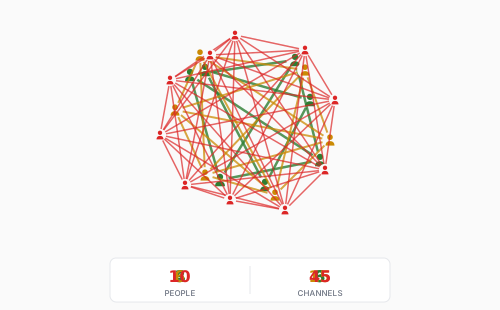
Effort stays high. The Ringelmann Effect (1913) shows individual effort drops as team size grows: to 85% of solo output at 3 people, 49% at 8. Two mechanisms drive this: the Free-Rider Effect (“others will handle it”) and the Sucker Effect (“I’m not going to be the only one trying”). At three, accountability is inescapable. At four, the drift has already begun.
Mental models stay complete. Robin Dunbar’s research (1992) found that humans can maintain deep mental models of at most 5 people: knowing what they know, how they think, what they’re working on. At three, everyone holds a complete model of everyone else. That overlap is precisely what makes the shared 10-slot budget work: shared context means shared accountability.
Synthesis works. A University of Illinois study (2006) found that pairs create no collaboration advantage over the best individual, but groups of three consistently outperform. The third person isn’t just a tiebreaker. They’re a synthesis engine. Two people with different opinions deadlock. Three people can synthesize.
The convergence across all four dimensions (communication, motivation, cognition, synthesis) points to the same number:
- 2 people: Not enough (stalemates, no collaboration advantage)
- 3 people: Optimal (full accountability, complete mental models, synthesis capable)
- 4+ people: Declining returns (overhead grows faster than capacity)
Three people. Ten slots. That’s the budget.
When You Hit the Limit
When the slot count exceeds 10, you have exactly five options:
- Remove an existing feature: Kill what’s not earning its slot
- Simplify an existing feature: Reduce complexity to free capacity
- Buy instead of build: Use SaaS for auth, payments, analytics
- Split into two 3-person teams: Separate products, separate budgets
- Say no: Reject the feature request entirely
Notice what’s not on the list: “Add a fourth person.” The math makes that option a trap: you pay for a full salary but gain at most one marginal slot.
The teams that understand this build products that matter. The teams that don’t end up with ten features half-finished and a product nobody wants.
What the Constraint Forces
Having a budget is one thing. What matters is what it makes you do. The 10-slot limit forces three specific behaviors that larger teams systematically avoid.
It forces product focus. With only 3 people, every feature means something else doesn’t happen. No “strategic initiatives” or “exploratory features.” Just the single most important thing. Every slot occupied by a feature that doesn’t matter is a slot unavailable for one that does.
It forces simple architecture. Three people cannot maintain complex systems. A microservices architecture with a dozen services might cost 4-5 slots just in infrastructure, half your budget gone before you build a single feature. When you can’t afford that, you build clarity instead. Boring technology (PostgreSQL, REST, Django) costs almost nothing in cognitive overhead. Exotic technology costs real slots. Spend your innovation budget on features, not infrastructure.
It forces decision speed. Three communication channels versus 190. Decisions that take 30 seconds versus 30 days. No meetings about meetings. No approval chains. And no slots wasted on “alignment,” because three people sharing full context are already aligned.
These three effects compound. Simple architecture enables fast decisions. Fast decisions enable product focus. Product focus enables simple architecture. The constraint creates a virtuous cycle that larger teams struggle to access.
Why Architecture Follows Teams
That second effect, simple architecture, isn’t just a nice outcome. This is where the Inverse Cognitive Maneuver connects back to Conway’s Law.
Harvard’s analysis of 142 empirical studies found that 70% of organizations show strong “mirroring”: software architecture mirrors team structure. The researchers called it “an approach to technical problem-solving that conserves scarce cognitive resources.”
This is Conway’s Law operating at the team level. A 3-person team with no internal boundaries naturally builds unified architecture: a monolith, a single codebase, a coherent product. Not because monoliths are inherently “better,” but because there’s no internal boundary to mirror.
The moment you create internal silos (“Sarah owns auth, Mike owns payments”), those boundaries mirror into separate services and separate cognitive contexts. Slots get consumed on coordination instead of features.
The Inverse Conway Maneuver says: choose your boundaries deliberately. The Inverse Cognitive Maneuver adds: within a 3-person team, don’t create boundaries at all. Keep all context shared. Keep all 10 slots available for the product.
The Constraint in Practice
Theory is one thing. These companies lived it.
WhatsApp: Said No
Brian Acton wrote “No Ads! No Games! No Gimmicks!” Koum kept it taped to his desk. WhatsApp focused exclusively on messaging, reaching 450 million users with 55 employees. Before acquisition, they rejected stories, games, payments, video calls. Each “no” protected the slot budget. Every saved slot went to making messaging flawless.
Result: each employee supported ~8 million users. $19 billion acquisition.
Instagram: Cut Everything
Instagram started as Burbn, a check-in app with photos, location sharing, and social features. When Kevin Systrom and Mike Krieger analyzed usage data, people were skipping the check-in features and going straight to photo-sharing.
The decision: remove everything except photo-sharing. Two people, one decision: focus on the single feature people actually used.
At acquisition: exactly one flow. Take photo → Apply filter → Post → View feed. Thirteen employees. $1 billion.
Telegram: Architectural Clarity
Pavel Durov built Telegram with his brother Nikolai after fleeing Russia. No outside investors. No board pressure. Just 30 engineers who knew exactly what they were building.
They chose technologies they understood deeply: MTProto (their own protocol), a custom distributed infrastructure, native apps on every platform. No slots wasted on unfamiliar paradigms. When competitors adopted trendy microservices architectures, Telegram stayed with what fit in their heads.
1 billion users. $30 billion valuation.
Basecamp: Removed Features
When Basecamp launched “Basecamp Next” in March 2012, they created two lists: features they were adding, and features they were removing. Time tracking made the “Goodbye” list. Not broken. Not unpopular. Just not worth the complexity.
Jason Fried’s philosophy: “Every time you add something you take something away.” While most project management tools piled on Gantt charts, resource leveling, invoicing, and reporting, Basecamp went the other direction, stripping features down to the essentials. Twenty-five years later: still profitable, still small, still simple. Competitors raised hundreds of millions just to keep up.
Supercell: Kill What Doesn’t Fit
Supercell is named after its structure. The Finnish gaming company organizes into autonomous “cells” of five to fifteen people, each operating as an independent company. Cells choose what to build, how to build it, and, critically, whether to kill it. CEO Ilkka Paananen calls himself “the world’s least powerful CEO.” Management’s job is to stay out of the way.
Cells are larger than three, but the principle scales: each cell is small enough that every member holds the full game in their head. No sub-teams, no internal handoffs. The cognitive budget stays real.
Most games are killed not by leadership, but by the cells themselves. Clash of Clans was built by six people in six months. The result: $2.3 billion in revenue with fewer than 200 employees, while major publishers needed thousands across hundreds of games.
Each cell’s slot budget is self-enforced: if a game isn’t earning its slots, the cell kills it and starts over.
$10.2 billion valuation. Its first four games each hit the global top-10 grossing charts.
Evernote: What Happens Without the Constraint
Evernote was valued at $1 billion in 2012, the same year as Instagram’s acquisition. Both were simple, single-purpose apps that reached billion-dollar valuations in the same year.
Instagram stayed focused. Evernote didn’t.
By 2015, Evernote had added Work Chat, Context, Scannable, Skitch, Penultimate, Food, Hello. Seven separate apps plus dozens of features in the main product. The company grew to 450+ employees. Every new app consumed slots. Every slot drained focus from the core product.
Former CEO Phil Libin admitted they’d “lost focus.” Users complained the core product was neglected.
Instagram: 13 people → $1B → now 2B+ users. Evernote: 450+ people → never IPO’d → acquired by Bending Spoons, entire staff laid off.
The pattern: WhatsApp, Instagram, Telegram, Basecamp, and Supercell enforced the 10-slot constraint. Evernote ignored it. The budget doesn’t care whether you believe in it.
The Obvious Objections
“But my product genuinely requires more complexity.”
Some products do. Operating systems, large-scale enterprise platforms, and regulated industries like healthcare and finance have irreducible complexity that three people can’t contain. This article isn’t arguing otherwise.
But most software isn’t an operating system. The question isn’t whether large teams are ever necessary. It’s whether your team is large because the problem demands it, or because you haven’t yet made the architectural decisions that would make it unnecessary. WhatsApp served a billion users. Instagram reached a billion-dollar exit on Django with 13 people. If your problem requires more people, it’s worth asking: is that genuine complexity, or accumulated complexity from years of not having this constraint?
“Our competitors have 50 features. Customers expect feature parity.”
Do they? Or do customers expect the problem solved?
WhatsApp competed against Skype (video, voice, screen share, file transfer, SMS, landline calls). WhatsApp offered messaging. WhatsApp won. Instagram competed against Flickr (albums, groups, stats, pro accounts, printing). Instagram offered one flow. Instagram won.
Customers don’t buy features. They buy outcomes. A focused product that solves one problem completely beats a bloated product that solves ten problems partially. If your market “requires” 50 features, you may not be in one market. You’re in ten. The constraint helps you pick one and dominate it.
Warning Signs
Here’s how to tell when your team has exceeded its slot budget.
Early warnings:
- Can’t explain the architecture in 10 minutes
- New features require changes across multiple unrelated modules
- A team member doesn’t understand part of the codebase
Critical signs:
- Afraid to change certain files
- Bugs take days to track down
- Features take 2-3x longer than similar past features
Recovery: Pause features. Simplify now: delete unused code, consolidate services, remove premature abstractions. If you can’t simplify enough, your product may have genuinely outgrown the team.
The litmus test: “Can 3 people hold this entire system in their heads?”
If not, it’s too complex. Simplify or split.
Scaling: Multiply Teams, Don’t Grow Them
At some point, a single 3-person team won’t be enough. When that happens, the natural instinct is to hire person #4. But as we’ve seen, the math works against you.
The alternative: multiply teams. Two 3-person teams. Then three. Then ten.
This creates a new question: how do teams work together without recreating all the coordination overhead you just avoided?
The answer connects back to the 10-slot budget. When your team depends on another team’s service, you hold three things in mind (the contract, the failure behavior, the contact person) and these compress into one cognitive chunk: “the Identity API.” You don’t need to hold their internal architecture, database schema, or deployment pipeline. That’s the key insight: a well-designed connection costs only 1 slot. The API boundary hides implementation details, keeping each team’s 10-slot budget intact.
When to split: watch for knowledge concentration, when 1 of 3 people holds most of the critical system knowledge. “Only Alice understands auth” predicts burnout, incidents, and knowledge walking out the door when she leaves.
When you see that pattern and all 10 slots are consumed, don’t just add headcount. First, exhaust simplification. If you still can’t fit, look for a cluster of 3+ related slots that could sit behind a single API. If such a cluster exists, splitting saves capacity. If it doesn’t, splitting creates more overhead than it removes.
How the best companies do this: Amazon’s two-pizza teams scale through what they call “mitosis”: when demand for a service grows, they split the team into two smaller teams rather than expanding. Each team gets single-threaded ownership of a sub-area, a single fitness metric to optimize, and autonomy to execute. Amazon’s API mandate enforces the boundary: all teams communicate only through service interfaces, no backdoors, no shared databases. Thousands of engineers scale because each team holds only their own slots plus 1-slot connections.
The same pattern shows up everywhere.
Linear scopes projects to 1-3 weeks with teams of 1-3 people. If it can’t be done in that scope, they reduce scope rather than grow the team.
Basecamp’s rule: “Want to do more than two people can do? Add another two-person team on something else. Don’t add them to what you’re doing.”
Valve takes it further: $17 billion in revenue with 350 employees, no managers, self-selected small teams. The model works even at massive scale.
Each approach enforces the constraint differently, but the principle is identical: keep each team’s cognitive budget at 10 slots, and connect teams through 1-slot interfaces.
Starting Monday
The Inverse Cognitive Maneuver isn’t a philosophy to admire. It’s a practice to adopt. Here’s how to start.
Map your slots. Spend 30 minutes with your team listing every feature, technology, and dependency you actively maintain. If the count exceeds 10, you’ve identified the problem.
Kill or simplify until it fits. For each item above 10, ask: can we remove this? Simplify it? Buy it off the shelf? If none of those work, you’ve found a genuine split boundary.
Protect the budget going forward. Every feature request, technology choice, and new dependency must answer one question: which slot does this replace? If the answer is “none, we’ll just add it,” the answer is no.
The question isn’t whether you can succeed with small teams. The companies in this article already showed you can. The question is whether you’ll enforce the constraint when it gets uncomfortable. When the feature requests pile up, when hiring seems easier than saying no, when complexity feels inevitable.
The constraint doesn’t tolerate complexity. That’s the point.
References
Foundational Research
- (1975). The Mythical Man-Month . Addison-Wesley
- (1913). Ringelmann Rediscovered: The Original Article . Journal of Personality and Social Psychology
- (1992). Neocortex size as a constraint on group size in primates . Journal of Human Evolution
- (2006). Groups perform better than the best individuals on letters-to-numbers problems . Journal of Personality and Social Psychology
- (2001). The magical number 4 in short-term memory . Behavioral and Brain Sciences
- (2016). The mirroring hypothesis: theory, evidence, and exceptions . Industrial and Corporate Change
Architecture & Methodology
- (1968). How Do Committees Invent? . Datamation
- . Conway's Law . martinfowler.com
- (2015). Choose Boring Technology . mcfunley.com
Company Examples
- StartupTalky (2025). How Telegram Built a Billion-Dollar Empire with Just 30 Employees
- NBC News (2014). WhatsApp's 55 Employees Are Rich
- Inshorts (2022). WhatsApp's 'No Ads! No Games! No Gimmicks!' note
- TechCrunch (2012). Facebook to Acquire Instagram for $1 Billion
- Startup Archive. How Kevin Systrom Pivoted Burbn Into Instagram
- Signal v. Noise (2012). Basecamp Next: The Goodbye List
- . Every Time You Add Something You Take Something Away . Signal v. Noise
- (2023). Just the Two of Us . 37signals
- GDC Vault (2018). The Cell Structure: How Supercell Turned the Traditional Org-Chart Upside Down
- Wikipedia. Supercell (company)
- Game Developer (2018). Less Management, More Success: Inside Supercell's Upside-Down Organization
- Oliver Wyman (2018). Teams of Rivals: A New Approach to Agility
- Mobile Dev Memo (2016). Why is Supercell Worth Billions?
- SoftBank Group (2016). Tencent to Acquire Majority Stake in Supercell
- TechCrunch (2012). Evernote Reaches $1 Billion Valuation
- Fast Company (2017). Evernote Looks Back On A Tumultuous Few Years
- Business Insider (2015). Evernote Is In Deep Trouble
- Inc. (2016). Evernote CEO Phil Libin
- TechCrunch (2022). Bending Spoons Acquires Evernote
- Backlinko (2024). Instagram Users Statistics
- Tom's Hardware (2025). Valve makes almost $50 million per employee
- (2023). How Linear Builds Product . Lenny's Newsletter
- (2011). Stevey's Google Platforms Rant . GitHub Gist
- AWS. Amazon's Two-Pizza Teams